I'm going back to China, leaving this afternoon for the southern city of Guangzhou (Canton). My plan is to explore the south a little, before going to Shenzhen (next to Hong Kong) for two weeks to take part in a seminar programme - I'll be talking to Chinese school students who want to attend UK universities on transferable skills and banking. Finally, I hope to fit a trip to Shanghai into the last week or so before returning to Blighty in time for a cousin's wedding on the 9th of August.
On the PhD front - we've just subbmitted the first paper that I've been involved with since starting (on high-magnetic-field quantum oscillations in oxypnictide superconductors, http://arxiv.org/ftp/arxiv/papers/0806/0806.4726.pdf) to Nature - hopefully we'll know wether they've accepted it by the time I touch down in China (tomorrow evening)!
Showing posts with label physics. Show all posts
Showing posts with label physics. Show all posts
Wednesday, 9 July 2008

Tuesday, 4 September 2007
On tour
As this is my last week, there were a few things that needed to be done. On monday, another student and I went to the other part of the university to collect my certificate (they've really excelled themselves here, its a lovely one in a nice red covered folder with golden lettering, nice!), and bought my train ticket to Hunan for next week on the way.

In the afternoon, our professor took us to see the Shanghai Institute of Applied Physics, not far away but there was heavy traffic so it took about an hour to drive each way! They have some fairly advanced kit there and do lots of experiments - some of the students from the university go there to do various things to their samples.

This is our professor admiring a poster of the Pelletron that they have there. It was imported from the states in the 80's but is still very useful. The big round bit was as big as a room, and generates a very high energy ion beam.This can be sent down any of the five tubes and used as a very powerful microscope. It is currently being used a lot by environmental scientists trying to clean up Shanghai's air pollution.
The things that are really standing out to me from the summer are the difference in the amount of experimental work we do at Cambridge and here at Shanghai. I've done 4 years and got a masters already, but the only serious experimental work (besides a few assessed practicals in the first few years) we do is our 4th year project - and even then, mine was computational so not a clamp stand in sight! By contrast, in Shanghai a masters takes 6 years (although they have to study a fair amount of compulsary English and 'Politics' as well during that time), the last two of which are purely practical, doing experiments and publishing papers. Some of the 4th year projects at Cam might have lead to papers, but on the whole we don't start publishing until PhD level. I'm quite looking forward to actually doing some experimental stuff after my time here!

This is an electron microscope they had. The two darker bits on the left were actually made in England - they were imported from one of the more mediocre universities there that shares it's hometown with Oxford Brookes.
Saturday, 1 September 2007
Boating on the Huangpu
This week has passed fairly quickly. Got the results for our experiment through on Thursday and I've been playing around with them making some graphs and the like. As I mentioned before, the results were not quite as useful as I might have liked due to the alteration in the process now used at the factory, but it's been fun either way and we'll see what I come up with. We measured lots of weights at different stages in the process which we can use to calculate thicknesses and things, and also power output of the cells which we can compare to thickness, weight etc.

Today (Saturday), I decided to go on the Huangpu River cruise. There are a few versions, but they boil down to a 1-hour tour that basically covers the Bund for about 60 RMB, or a bumper 3-hour cruise 60km downstream to the mouth of the Yangtze and the Pacific Ocean for 150 RMB. Being a purist and on the advice of my guidebook, I went for the longer one. It was good, and my first view of the ocean not from an aeroplane, but in retrospect I think 3 hours is a bit gruelling - advice for others, go for the shorter cruise! Although it is certainly worth doing that one.

Jack plans revolution with his Bolshy buddies near the pier

Leaving Pudong behind...

The gate to the East
Afterwards wondered Xin Tan Di and Huai Hai Lu with a few others (the nice bits of town!) and restaurented and malled. Developed a game for malls: essentially you need to travel the men's floor without retracing your steps, and return to your initial position (if lift, or the down escalator otherwise). The catch is, if there's a plastic clothes model with it's shirt tucked in, that walkway section is forbidden!

blocked!

China's military will soon be able to take over the World, but like the Americans they appear not quite to have grasped 'soft' power yet. Their attempts at cultural supremecy have so far only won over Alan from 'Two and a half men' and my younger, and far wiser brother.
Tomorrow I'm off dragon boating, and then next week (my last!) is quite action packed, with a visit to a couple of other research institutes in Shanghai and possibly poping over to the other campus in Shanghai Uni to see what goes on over there, and hopefully I'm going to be allowed to sit in on some undergrad lectures (which have just started) and see what they're like over here.
Sunday, 26 August 2007
Hanzhou, Experiment, Art
Last saturday I went to Hanzhou. As i mentioned before, Hanzhou and Suzhou are supposed to be the most beautiful places in China. Personally, I'd cut Suzhou out of the list: Hanzhou was much nicer! It's a medium sized city built around a huge and lovely lake, surrounded by hills with tea plantations and lots of temples and pagodas. The gardens of Suzhou are indeed beautiful, but all of Hanzhou is.
We arrived quite late (circa 9.30pm), but were able to relativly quickly find a restaurent that opened late (cf. McD's in Suzhou!), before retreating to a moderatly priced hotel. However, their air conditioning was broken, so they shipped us upmarket for the first night for free! What a score. Next morning we had a breakfast buffet, all you want of a wide array of eastern and western foods.
 I knew that my friend and regular blog correspondant Lisa Gao had planned to come to China at some point this holiday, but I hadn't expected to find her in my fruit bowl at the hotel
Breakfast isn't big in China so its always slightly eclectic, but not here. Lots of chinese dumplings, noodles etc., but also the full array of bacon, potatoes, cereal, cold milk, fruit, fruit juice, french pastires etc - I stuffed myself full for the day.
On sunday we visited the Lingyin Temple, a big budhist temple. It's just over the hill from the lake and is in the middle of the tea growing areas. Next to it is a famous hill called "Hill flown in from afar" after a travelling Indian buddhist mistook it for a hill from home which it resembled, which we climbed. The temple itself is still home to several buddhist monks, who climb another even taller hill each day on their hands and knees to visit another temple (which you can just see at the top of the tea field photo below, with a cable car for lazy tourists), and clean, worship and practice martial arts (allegedly). They seem to have struck on a winning revenue stream though - there are thusands of tourists daily, who come to burn incense and worship their family gods (apparently buddhism adopted gods when it reached china).
 buddhas carved into 'hill flown from afar'
 despite numerous signs informing that for true buddhists piety is more important than incense, the vendors outside still made a healthy taking. The chinese aren't the most religious of people, but they have a very special way of sinocising foreign ones
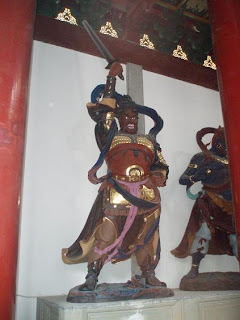 Buddhism, much like Islam, is a religion of peace
After the temple, we went to try and find the tea museum, but it was unfortunatly out of season. Instead, we got taken to one of the tea villages to a little tea huse to have tea explained to us by a local woman. We wondered the village for a bit and bought some overpriced locally cut stuff, then returned to our original hotel (unfortunatly repaired!) for a shower.
 proof I was there
 A tea field. I want one of these!
In the evening we went to a nice restaurent on the lake (my first glimpse of it so far!) that was packed, apparently Zhou En Lai ate there back in the day so it's always popular with domestic tourists. We wondered a bit afterwards, along one of the long causeways that cross the lake, before returning to the hotel.
We woke early the next morning for another marginally less impressive breakfast, less bacon and more rice but still palatable. No black tea either unfortunatly. We went back to the lake and hired bicycles from one of the many hire places around the lake and cycled round it for a few hours, which was really good fun and very pretty.
 part of Hanzhu's beautiful West Lake
It was almost time to go after this, we had lunch at a nice Guangdong themed restaurent (the bit of China nearest Hong Kong, known for eating anything!) and headed back to Shanghai in the glorius monday sunshine.
All was good until I got back home, and discovered to my horror (and for the second time) that I'd lost my debit card. Further, my laptop seemed well and truly broken and I was a bit gutted. Luckily, some frantic calls later revealed that it had been left in the first hotel, they were very good and sent it off almost straight away. Laptop was less positive.
On tuesday Professor Ma arrived back, and the students and I and he discussed various plans for experiments. I got the go-ahead for mine, and my and another student decided to travel over to Pudong on wednesday evening. It was Yaoyao's birthday dinner in shanghai that night in Shanghai, she took several of us to an 'italian' restaurent. It's no wonder that Chinese people think they don't like western food - the imitation is pale (much like chinese takeaway in the UK i'm sure!). The pizzas we had were greasy, covered in horrible rubbery cheese, not a tomato i sight, the tuna (I'm a big fan of napolitana in the UK...) could have come from a can, not enough vinegar, bread too thick, no chilli oil, no pepper mill, etc... The potato salad side order was very good, however!
In the day on Wednesday we had some american visitors to the lab who I chatted to for a bit, they were the investors from the company but seemed to be more on the business than the science side. When we arrived at the company that afternoon I saw them again and told them my plans! It was late so I and the student (his english name is Bob!) headed to the dormitary nearby to start the next morning.
 Our village, complete with a few words from the big man himself (5 ft 0 Deng. Party man Bob is a very big fan)
The village that the dorm is in is right on the outskirts of Shanghai where it merges with the countryside (and the coast!), and I've got some good photos of it. When I left it before a few weeks back, some workers had been clearing weeds from a large area of ground, which has now just about been turned into a nice paved area with trees and benches. Development is rapid.
 then
 and now
 Shanghai's eastern edge
By Thursday morning, I was very keen to get by experiment under way. I'd spent some time fighting through paperwork, and finally got to the factory floor by about 10am, to find that the crucial stage of the process for my experiment is no longer used! We had to adjust it somewhat, and the results were less useful that I'd hoped. However, carrying it out was good fun and the company are planning to do my original experiment themselves at some point now which is great.
We finished early on Friday afternoon, and Bob and I returned via SHanghai centre. We went to a nice little market, and did some souvenir shopping. I have purchased a Chinese chess set which I now need to learn to play, and several other amusing nicnaks. I also aquired the newest harry potter for 20 RMB (1 pound 30) and a compilation of shakespeare plays in english and chinese.
 Certified 'World VIP' Ma Sun carves me a name stamp
On Friday night I went out with Valencia and Kenny and several others, first to an interesting club in south Shanghai called 'Absolute House', before moving on to Attica. As usual Valencia had obtained us free entry to both places and drinks so the night was very cheap. After we left attica we wondered shanghai and ate funny shellfish as the sun came up!
On Saturday I went with Toshiba to Century Park - a very large park in central pudong not far from the Jin Mao tower. It was very nice, with a big lake in the middle that we were able to hire a boat and sail around on for a bit! After that we went to see the latest Harry Potter in the cinema (I'm not addicted!) and had dinner at an italian place much nicer than the one I went to on tuesday! Still not enough tomato tho and very overpriced this time: someone needs to bring Pizza Express or ASK here.
 captain Jack
 Shiji Park
On sunday, Valencia wanted to go to the Shanghai art museum. Very tired from the busy week I skipped Dragonboating to sleep, and on a whim joined her in the afternoon to go and see the special exhibit: lots of Gaudi's work from early 20th century Spain. We explored people's square afterwards, and got the usual approaches from 'tea shop' people trying to get money out of us - she was very surprised, and said it was a totally different experience from when she was alone! She thinks they might not know how to deal with a western woman, but I put it more down to her fluent Chinese - a good few people were taken by surprise when she jabbered back at them!
 Gaudi was a big fan of 'hyperbolic perabaloids'. Obviously.
 upstairs they had quite an strange mix of his furniture
 he had a change of heart on his death bed - form AND function
Anyway, she had had to visit a nearby restaurent at some point as part of her job, called Saigon Blue, so we decided to have dinner there (unsurprisingly Vietnamese). It was a lovely little restaurent but a little bit out of the way, a few streets south of Nanjing Road and not quite in the french concession, and also hidden by a large strange hotel-like building (but not a hotel, apparently) called the 'Overseas Chinese Development Center'. You had to actaully leave the restaurent and enter the building to go to the loo, which might have been cold in the winter and felt a little strange! They want to change the place into a bar with V's company's help, but she wasn't massivly enthused. The food was very good though: we had lots of fresh veg in salads and spring rolls, which made me realise how much I've missed them - almost all vegetables here are stir fried or cooked in sauce (side note: I also spotted a subway tucked away near people's square which I will be visiting SOON!).
We wondered a little bit afterward before heading our seperate ways - she made me laugh at one point by suggesting we go for a foot massage - before I realised she was serious! After all the dodgy 'massaji' calls that one hears outside clubs in the early morning I wouldn't even have thought about it, but she told me about the wonderful massage she'd had the week before. It's a very different experience here for men and women! She has promised to take me with her next time she goes to translate for me and guarantee no unexpected surprises!
We arrived quite late (circa 9.30pm), but were able to relativly quickly find a restaurent that opened late (cf. McD's in Suzhou!), before retreating to a moderatly priced hotel. However, their air conditioning was broken, so they shipped us upmarket for the first night for free! What a score. Next morning we had a breakfast buffet, all you want of a wide array of eastern and western foods.
 I knew that my friend and regular blog correspondant Lisa Gao had planned to come to China at some point this holiday, but I hadn't expected to find her in my fruit bowl at the hotel
Breakfast isn't big in China so its always slightly eclectic, but not here. Lots of chinese dumplings, noodles etc., but also the full array of bacon, potatoes, cereal, cold milk, fruit, fruit juice, french pastires etc - I stuffed myself full for the day.
On sunday we visited the Lingyin Temple, a big budhist temple. It's just over the hill from the lake and is in the middle of the tea growing areas. Next to it is a famous hill called "Hill flown in from afar" after a travelling Indian buddhist mistook it for a hill from home which it resembled, which we climbed. The temple itself is still home to several buddhist monks, who climb another even taller hill each day on their hands and knees to visit another temple (which you can just see at the top of the tea field photo below, with a cable car for lazy tourists), and clean, worship and practice martial arts (allegedly). They seem to have struck on a winning revenue stream though - there are thusands of tourists daily, who come to burn incense and worship their family gods (apparently buddhism adopted gods when it reached china).
 buddhas carved into 'hill flown from afar'
 despite numerous signs informing that for true buddhists piety is more important than incense, the vendors outside still made a healthy taking. The chinese aren't the most religious of people, but they have a very special way of sinocising foreign ones
 Buddhism, much like Islam, is a religion of peace
 proof I was there
 A tea field. I want one of these!
We woke early the next morning for another marginally less impressive breakfast, less bacon and more rice but still palatable. No black tea either unfortunatly. We went back to the lake and hired bicycles from one of the many hire places around the lake and cycled round it for a few hours, which was really good fun and very pretty.
 part of Hanzhu's beautiful West Lake
It was almost time to go after this, we had lunch at a nice Guangdong themed restaurent (the bit of China nearest Hong Kong, known for eating anything!) and headed back to Shanghai in the glorius monday sunshine.
All was good until I got back home, and discovered to my horror (and for the second time) that I'd lost my debit card. Further, my laptop seemed well and truly broken and I was a bit gutted. Luckily, some frantic calls later revealed that it had been left in the first hotel, they were very good and sent it off almost straight away. Laptop was less positive.
On tuesday Professor Ma arrived back, and the students and I and he discussed various plans for experiments. I got the go-ahead for mine, and my and another student decided to travel over to Pudong on wednesday evening. It was Yaoyao's birthday dinner in shanghai that night in Shanghai, she took several of us to an 'italian' restaurent. It's no wonder that Chinese people think they don't like western food - the imitation is pale (much like chinese takeaway in the UK i'm sure!). The pizzas we had were greasy, covered in horrible rubbery cheese, not a tomato i sight, the tuna (I'm a big fan of napolitana in the UK...) could have come from a can, not enough vinegar, bread too thick, no chilli oil, no pepper mill, etc... The potato salad side order was very good, however!
In the day on Wednesday we had some american visitors to the lab who I chatted to for a bit, they were the investors from the company but seemed to be more on the business than the science side. When we arrived at the company that afternoon I saw them again and told them my plans! It was late so I and the student (his english name is Bob!) headed to the dormitary nearby to start the next morning.
 Our village, complete with a few words from the big man himself (5 ft 0 Deng. Party man Bob is a very big fan)
The village that the dorm is in is right on the outskirts of Shanghai where it merges with the countryside (and the coast!), and I've got some good photos of it. When I left it before a few weeks back, some workers had been clearing weeds from a large area of ground, which has now just about been turned into a nice paved area with trees and benches. Development is rapid.
 then
 and now
 Shanghai's eastern edge
We finished early on Friday afternoon, and Bob and I returned via SHanghai centre. We went to a nice little market, and did some souvenir shopping. I have purchased a Chinese chess set which I now need to learn to play, and several other amusing nicnaks. I also aquired the newest harry potter for 20 RMB (1 pound 30) and a compilation of shakespeare plays in english and chinese.
 Certified 'World VIP' Ma Sun carves me a name stamp
On Friday night I went out with Valencia and Kenny and several others, first to an interesting club in south Shanghai called 'Absolute House', before moving on to Attica. As usual Valencia had obtained us free entry to both places and drinks so the night was very cheap. After we left attica we wondered shanghai and ate funny shellfish as the sun came up!
On Saturday I went with Toshiba to Century Park - a very large park in central pudong not far from the Jin Mao tower. It was very nice, with a big lake in the middle that we were able to hire a boat and sail around on for a bit! After that we went to see the latest Harry Potter in the cinema (I'm not addicted!) and had dinner at an italian place much nicer than the one I went to on tuesday! Still not enough tomato tho and very overpriced this time: someone needs to bring Pizza Express or ASK here.
 captain Jack
 Shiji Park
On sunday, Valencia wanted to go to the Shanghai art museum. Very tired from the busy week I skipped Dragonboating to sleep, and on a whim joined her in the afternoon to go and see the special exhibit: lots of Gaudi's work from early 20th century Spain. We explored people's square afterwards, and got the usual approaches from 'tea shop' people trying to get money out of us - she was very surprised, and said it was a totally different experience from when she was alone! She thinks they might not know how to deal with a western woman, but I put it more down to her fluent Chinese - a good few people were taken by surprise when she jabbered back at them!
 Gaudi was a big fan of 'hyperbolic perabaloids'. Obviously.
 upstairs they had quite an strange mix of his furniture
 he had a change of heart on his death bed - form AND function
Anyway, she had had to visit a nearby restaurent at some point as part of her job, called Saigon Blue, so we decided to have dinner there (unsurprisingly Vietnamese). It was a lovely little restaurent but a little bit out of the way, a few streets south of Nanjing Road and not quite in the french concession, and also hidden by a large strange hotel-like building (but not a hotel, apparently) called the 'Overseas Chinese Development Center'. You had to actaully leave the restaurent and enter the building to go to the loo, which might have been cold in the winter and felt a little strange! They want to change the place into a bar with V's company's help, but she wasn't massivly enthused. The food was very good though: we had lots of fresh veg in salads and spring rolls, which made me realise how much I've missed them - almost all vegetables here are stir fried or cooked in sauce (side note: I also spotted a subway tucked away near people's square which I will be visiting SOON!).
We wondered a little bit afterward before heading our seperate ways - she made me laugh at one point by suggesting we go for a foot massage - before I realised she was serious! After all the dodgy 'massaji' calls that one hears outside clubs in the early morning I wouldn't even have thought about it, but she told me about the wonderful massage she'd had the week before. It's a very different experience here for men and women! She has promised to take me with her next time she goes to translate for me and guarantee no unexpected surprises!
Wednesday, 15 August 2007
Experiment
I got a good news phone call this morning from one of the guys at the solar panel ompany, they've decided to let me do the experiment that I've been planning for a bit! Basically the massive majority of the cost of solar panels is the silicon that they use for it itself. It has to be so pure that they need some very energy intensive methods to purify it far enough (solar panels aren't quite as green as people like to think, they spend about half of their lives paying back the energy it cost to make them and they also leave a trail of chemical nasties) which is expensive. Consequently, people are looking at many new types of panel that need less material to work.
The easiest solution, of course, is simply to use thinner panels - which is exactly what I want to try. The problems include that they will be more fragile, and also that they will bend more during the sintering (heatin at about 500 degrees C) that they undergo, which might make them not work. On the other hand, any thickness reduction means big cost cuts, so it might be worth it. I want to basically thin some slices down about 10 or 20% and see what the effect is on their power output at the end, it's something that they've been interested in before but haven't actually tried yet, and I think they're keen to see what happens. They also have a new machine fairly recently that will allow very good thickness measurements.
My professor returns on Monday, so I'll probably try and get over there on tuesday to begin, and it might take the rest of the week to get done, but should be a lot of fun!
In other news, I finally cracked last night at the expat event and ordered the following monster:

I've been told on certain streets you can even find proper Turkish kebabs in polystyrene boxes, so I'm going to have to hunt one of those down next time. There is documentary proof of my betrayal of chinese food at http://www.shanghaiexpat.com/modules.php?set_albumName=album06&id=IMG_1010_001&op=modload&name=mdGallery&file=index&include=view_photo.php it's photo 19 if it doesn't come up automatically!
After the expat event Valencia got us guestlist entry and free drinks at the surprisingly retro disco club G Plus in a swanky mall in Xin Tan Di (her company helps market things in Shanghai. Apparently the locals tend to spend more in clubs than stingey foreigners, but they prefer clubs that have a few around and thus spend even more, so clubs like to encourage us to visit them). Very good club with good music and a very '80s mirrored theme, my only complaint (as with so many clubs here) was the narrow passageways and the insane amount of space dedicated to tables (which is how clubs here seem to make most of their money). On the whole big thumbs up tho!

Thursday, 19 July 2007
Shanghai Solar!
This one is going to be a little technical, my parents have asked for an update on my activities here inside work, so if you're not interested in physics, solar panels, or the physics of solar panels, you might as well skip it.
Last week started off mostly organisational, and I spent the first few days touring the factory working out how everything works and what gets done. The production line is manned about 16 hours a day (there are three work teams that rotate), but there are also teams of engineers, who are there to fix problems, manage, and I think also deal with clients and expriment and things.
So after a few days, I wanted to do something.There is a control room in the factory where all the cells get tested before being assembled onto the panels, and the room also has a few other testing devices. One of them tests reflectivity of a sample, and since it was available, I thought I'd use it. At each stage of the production there are a few breakages, so I used some of these from different stages to check how reflective they were. Most interestingly, one of the stages involves aving the cells sprayed with titanium dioxide to form an anti-reflective layer. If light hits bare silicon, a significant portion of the energy is reflected away because light travels so much more slowly inside it than it does in the air (this is roughly why you can see a faint reflection of yourself in glass windows, since not all of the light that bounces off your face passes straight through the window, a small amount bounces back. If you look at a window that doesn't have much light coming from the other side, eg. look outside at night, it's much easier to see this effect). It turns out that if you choose an intermediate layer perfectly and have the right (very thin) thickness, you can stop all light of a certain wavelength from being reflected, and significantly reduce reflection at other wavelengths. Glasses and camera lenses use this effect, camera lenses look a bit purpley because they block green reflectionmore-or-less totally, but only reduce the red and blue reflection (which are on either side of green). Red + blue = purple.
In the factory, this layer is currently applied by people with spray guns and they judge the thckness by the colour of the sample (because it changes the reflective properties, the colour also changes as the spray is applied. Some factories use a more advanced piece of kit - they're gettig one fitted here in december - that is more accurate and improves power output of the finished cells by about 10%). I wanted to see what the measured reflectivity was with a bit less spray than usual and a bit more than usual (and of course the normal amount as a control and no spray as another control). The other student engineers were keen to help - they seem not to have much to do in the factory and hadn't really thought about doing their own experiments.
I got some data last friday from one set of samples, and was planning to get lots more early this week. Unfortunatly, however, the machine has broken and I haven't been able to get more data. (It wasn't actually due to me! I think they were quite interested in my idea, last Thursday my professor told one of the students looking after me that he should do a similar experiment, 20 samples from each stage and measure the reflectivity, but being much more careful about getting samples from the same batch, etc, as a longer term experiment. So the machine was getting a lot of use and at somepoint seems to have given up! There's another component coming next week to fix it).
So this week I've been putting together a model of the reflective properties using excel (and a lot of notebook space! Both my pens ran out on the same day and it was surprisingly tough to obtain a new one!). It's a fairly simple model but without access to my notes from the last few years it's taken abit of time to get my brain back into gear, although quite fun to have a go. I've been able to find silicon's refractive index data on the internet (refractive index is hw fast light travels inside it compared to a vacuum, and has a lot of effect on its reflective/refractive properties. A pencil in a glass of water looks bent because water has a higher refractive index than air, so the light bends on entry). I've been trying to fit the model to the dat I got last week, although to be honest one set of samples is far too few to be considered scientific, so I'm going to collect more data as soon as the machine starts to work again.

The model with the anti-reflective layer is a bit more complicated because of various different reflections inside the layer itself that depend on the thickness in quite a complicated way and all interfere with one another. However, the model is quite good and I've now adjusted it to take account of silicon's low wavelength behaviour as well.
Yesterday I was also looking at the absorption of sunlight by solar cells. A good 95% or so of all solar panels are the basic silicon ones like the ones they make here. There is lots of innovation around the world about other types, but most are constrained by cost or still very young technology. Unfortunatly, the maximum possible efficiency (the proportion of incident solar radiation that gets turned into electricity) in a normal silicon cell is about 32%, and most real cells are lower - the ones they make here are about 16% efficient. This limit is due partly to the solar spectrum, much of which falls at wavelengths that are too long to excite the electrons inside the silicon, and also due to the way that electrons that are excited behave - a lot of their energy is converted into heat inside the cell. There are lots of ideas about how to improve this (such as using mirrors to concentrate the light, altering the spectrum using clever materials, or using thing other than silicon) and I've been studying a review paper on the topic, but at the moment these are all some way from being practical.

Next week I'll get more data and then see where to go from there, and then after that I'll be back in the lab as Shanghai University which will have finished its refurbishment and able to try out some new experiments!
ps. Whats happening with Russia? Getting snippets on the news but noone here knows how to translate it. I *would* check the news websites, but it seems anything with 'news' in the website is blocked here...
Subscribe to:
Posts (Atom)